
Garden City Address History Sources
Garden City previous residents appear in dated layers, not in a single public file. The present Finney County parcel card supplies a parcel ID, situs address, legal description, and current owner. Recorded instruments then identify owners and interests at specific dates. Directories and census schedules are better evidence of occupation, while maps and permits explain how the lot or building changed. Start with the source closest to the date in question, then test it against a second kind of record.
| Source | Years It Covers | Where Held | What It Shows |
|---|---|---|---|
| Finney deed index | About 1987 to present; older images by book/page | Register of Deeds and changing online systems | Parties, instrument, date, legal description, image status |
| Older deed and plat books | Historic start not published | Register of Deeds; museum and state leads | Earlier owners, plats, easements, and lot identity |
| Garden City directories | Scattered leads from 1886-1887 through the 1960s | Library, FamilySearch, museum, and KHS leads | Dated names, addresses, work, and household clues |
| Federal census | Public schedules through 1950 | NARA and partner databases | Household members, ages, and address context |
| Sanborn maps | 1899, 1911, 1929, and 1950 revised | LOC, KHS, and NPS bibliography leads | Footprint, lot, street, and building use, not occupants |
For a recent transfer, use the parcel viewer and recorded deed first. For a mid-century household, compare a directory year with the nearest public census and newspaper issue. An early Garden City address may require a plat, deed book, Sanborn sheet, and historical county name. Online absence is not proof that no record exists because much of the older trail remains in books, microfilm, catalog records, or research-room files.
Anchor Garden City Past Residents
The Finney County Parcel Information Viewer is the best current anchor. Save the ParcelID or compact PID, Quick Reference ID, owner and mailing lines, property or situs address, legal description, subdivision, block, lot, and section-township-range. Situs means the place where the parcel sits; it can differ from the owner’s mailing address.
Do not infer that the named owner lives there. A trust, estate, company, or off-site owner may hold title. The legal description is more durable than a house number when parcels split, combine, or are replatted. The viewer is for reference and is not a legal survey, so preserve its date and move to the recorded instrument for proof.
Note: The viewer accepts hyphenated Parcel ID and compact PID formats, a useful shortcut when one form produces no result.
Garden City Deeds in Transition
The Finney County Register of Deeds records deeds, mortgages, releases, easements, plats, liens, and related land instruments. Its older RMIS route searched by name, book and page, document type, date, or legal description. County notes placed indexed searching around 1987 forward, with patent-to-present images and patent-through-1986 images found by book and page.
A July 2026 county notice says Finney County is implementing Fidlar AVID. Professional access is moving toward Laredo and Laredo Anywhere, with Tapestry planned for browser pay-per-search. The exact county landing page was not available in the research, so confirm the current route before paying. The office counter at 311 N Ninth Street and county phone, 620-272-3500, remain the fallback for copies and older books.
The county subscription page preserves the former RMIS coverage and access terms.
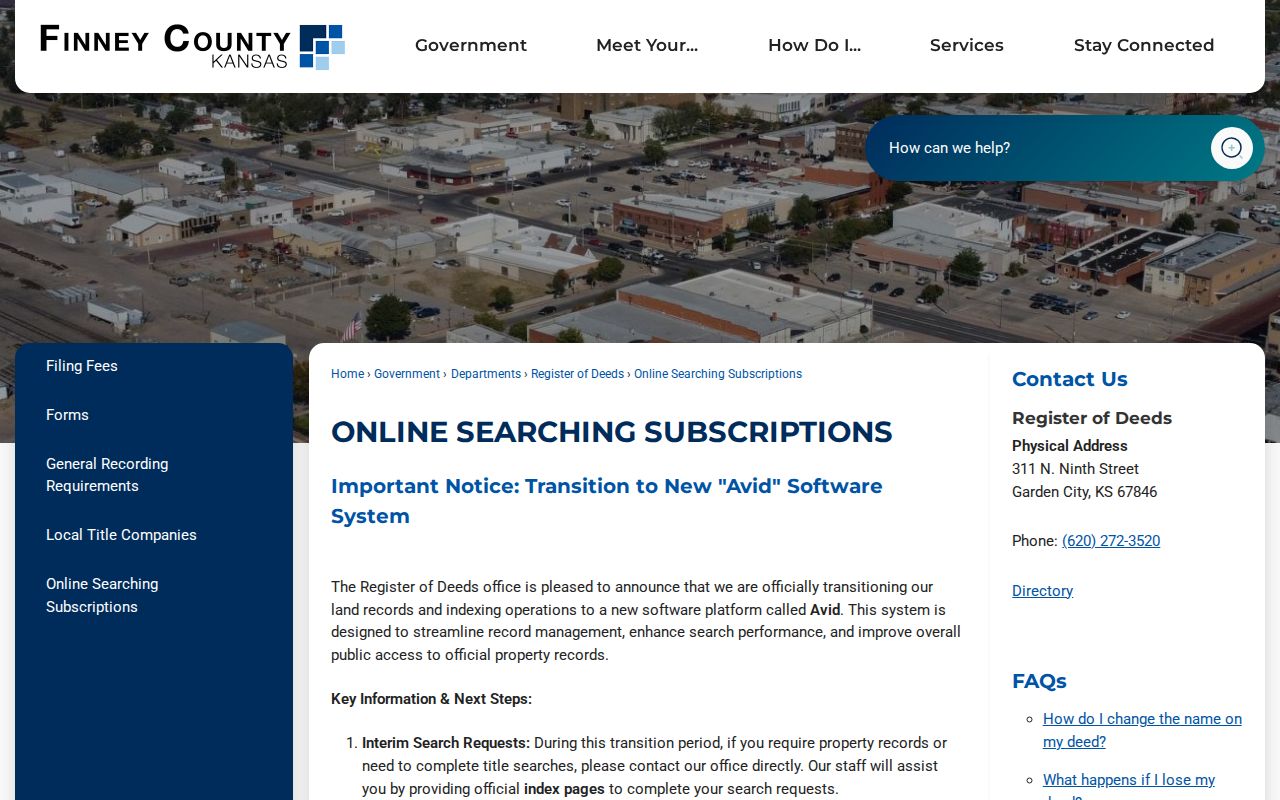
Its coverage notes are essential when a Garden City address trail crosses from name-searchable instruments into book-and-page research.
The older RMIS screen records the system used before the current migration.
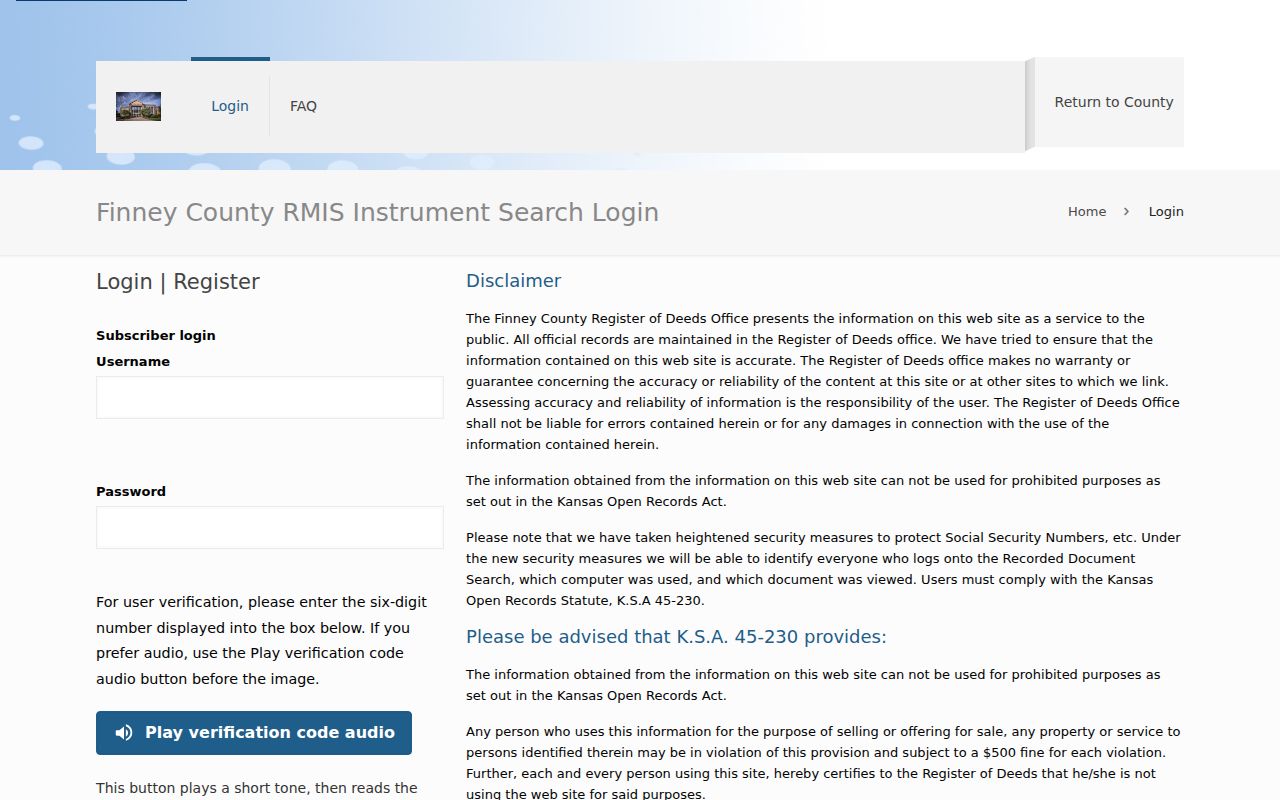
The login and disclaimer show why a researcher should retain instrument references and verify the live county route.
The transition matters when finding previous residents. A failed old login may reflect the software change, not a missing deed. Save each book/page or instrument number so staff can locate the same item even if the screen and search fields change.
Trace Finney County Owners Backward
A chain of title is the ordered series of transfers affecting one tract. Follow the legal description and instrument references, not just a repeated surname. Mortgages and releases can add dates but do not by themselves show that an occupant changed. A plat may identify a lot before it had its present street number.
- Copy the current owner, parcel identifiers, and full legal description from GIS.
- Find the deed in which that owner appears as grantee, the party receiving the interest.
- Record the grantor, date, instrument or book/page, document type, and legal description.
- Search the grantor as an earlier grantee, checking name variants, spouses, estates, trustees, and entities.
- When online coverage ends, take the last book/page and legal description to the Register’s paper or microphoto index.
- Grantor / grantee
- The grantor gives or transfers an interest; the grantee receives it.
- Chain of title
- The dated sequence of recorded transfers tied to the same land.
- Legal description
- The lot, block, subdivision, or survey text that identifies land apart from its postal address.
Match Old Garden City Addresses
No complete official Garden City street-renumbering schedule was found. That makes a modern house-number search risky for early records. Copy the address exactly as printed in each source, then compare its lot, block, plat, legal description, nearby streets, and landmarks. Do not silently replace an old number with a current one.
Jurisdiction can shift too. Kansas Historical Society material notes Finney County’s 1893 annexation of old Garfield County. A person or parcel that vanishes from a modern Finney search may sit under an older place or county reference. Search the historical name in deed, court, directory, and newspaper catalogs before marking the link unresolved.
Garden City Directory Checkpoints
Directory evidence for Garden City is scattered. Leads include an 1886-1887 Finney County directory, city volumes dated 1907, 1909, 1913, 1922, 1927, 1931, 1933 or 1940, 1948, and 1952, plus later bibliography clues. FamilySearch identifies a 1941 Southwestern Bell directory covering Garden City, Holcomb, Scott City, and Sublette. These are search leads, not proof that every scan is open online.
Use the edition nearest a deed event and record the printed name, address, page, publisher, and any cross-reference. A criss-cross directory is arranged by street and house number instead of surname. Local reverse-directory years were not verified, so ask the Finney County Public Library genealogy desk or the museum rather than assuming a continuous run. The collection details belong in the Garden City city directories reference.
Map Earlier Garden City Buildings
National Register bibliographies identify Garden City Sanborn map years of 1899, 1911, 1929, and 1950 revised. A Sanborn sheet can show a building footprint, use, construction details, lot lines, and the street name in use at that date. It cannot prove which person slept in the building.
Combine the sheet with a same-era directory and deed. That three-way check can distinguish a vacant lot, business, dwelling, or rebuilt structure. City planning, plat, and permit files can add later changes, but their historical coverage and public search fields were not established. Request a specific address, date range, and existing document through the proper custodian rather than asking the city to create a house history.
Garden City House Files Offline
The Leola Howard Blanchard Research Library at the Finney County Historical Museum holds original newspapers, photographs, maps, manuscript letters, and other primary sources. Research access is by appointment. Named Buffalo Jones, Finnup family, and Clifford Hope material can supply exact search terms when a property or family touches those collections.
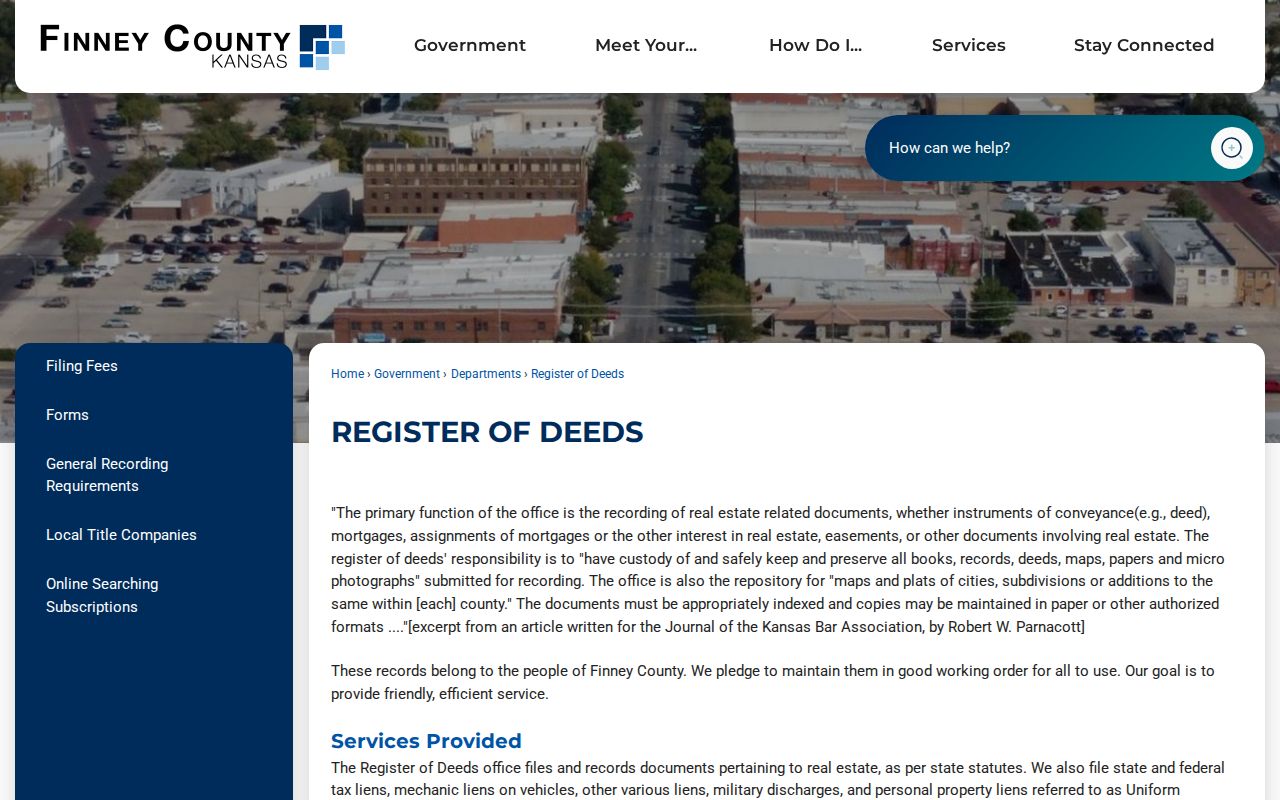
The office description makes clear that staff help researchers use the records but do not perform a title search.
The Garden City Telegram archive listed by the public library covers 1997 forward through NewsBank. Earlier papers may require museum or Kansas Historical Society microfilm. Moving notices, obituaries, building stories, business openings, and planning actions can place a person near an address, but each item needs its publication date and page. Newspaper wording should corroborate the property trail, not replace it.
Note: A catalog record shows that an item exists; confirm the repository, access terms, and page image before quoting an entry.
Garden City Past Household Evidence
Owners and previous residents are not the same group. Directories may list an occupant or business, census schedules can name a household, and deeds name parties to a land transfer. Pair the records without merging their claims.
- Choose a directory edition and transcribe the name, address, year, and page exactly.
- Find the nearest public census year, then identify the correct enumeration district, the area assigned to one census taker.
- Compare household names, ages, address order, nearby homes, and place boundaries.
- Use a deed, obituary, cemetery record, or newspaper item to test the link and assign it exact, strong, probable, or unresolved status.
Public individual census schedules now run through 1950 under the 72-year rule. Most of the 1890 census was destroyed, so a gap then is expected. Valley View and Sunset cemetery records, an obituary, or an eligible death-certificate request can close the trail for a deceased resident. Probate dockets may identify heirs, but no separate Finney probate index was found; use the Kansas court portal or district clerk and keep court identity separate from occupancy.
Lawful use. Research Garden City previous residents for house history, genealogy, and other lawful personal aims. Never use a record trail to stalk, harass, threaten, or expose a living person.